
How to get it wrong (to read a chart as a whole)
First part: be more like Virgo. Second part: be more like Pisces.

First part: Charts have deceiving looks.
Second part: The way we look at them is often too narrow.
First part: Beware of optical illusions!
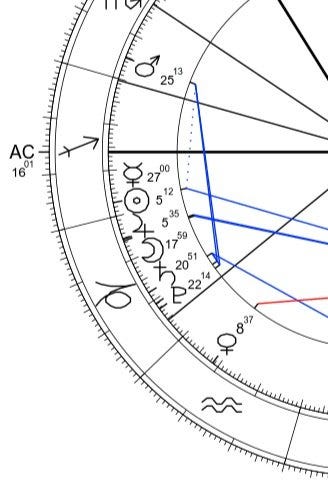
1 If several indicators are very close to one another, the chart is likely to display the symbols next to each other, and not in front of the little lines that indicate their exact position. You may see them far away from where they really are.
Also, you may not notice which ones are very close to each other, and which ones are more distant. Orbs matter though.
So put on your glasses, look at the little lines!
2 On Astrodienst, the default settings are 10 degrees orb for conjunctions, oppositions, trines and squares. You will see the same coloured lines for these aspects, independently of how tight they are.
For instance, imagine a Moon - Mars - Saturn T-square, with Saturn at the apex. The Moon is always a big player.
Let’s say the Moon - Saturn square is exact, and therefore really strong, but the Moon-Mars opposition , and the Mars - Saturn square exist with a 9 degrees orb.
Interpreting the Moon- Mars opposition without describing the Moon Saturn square first would be the equivalent of talking about a piglet in the room, whilst ignoring there is an elephant. Your interpretations won’t impress the querent. The other way round, starting with the elephant will be spot on, and then going as far as pointing out the piglet running between the elephant’s paws will come across as the cherry on top of the cake.
3 Some aspects may be minor but they do exist!
In the astrodienst format, minor aspects are represented by dotted lines. Semi squares or sesqui-squares are almost invisible. However, they may be exact to the degree or almost, and therefore more powerful than a loose major aspect. Again, put your glasses on!
Check the grid under the chart, and be prepared to calculate mentally. If Pluto is at 9 degree Scorpio and Venus at 24 degree Sagittarius, how tight is this semi square?
4 On astrodienst, if you’re using the default settings, Chiron is shown, but without aspects. I like it this way. It’s better not to have too many lines criss-crossing a chart. Sometimes people show charts with aspects to the angles, to the nodes and to a number of asteroids as well, and the result looks like a nervous breakdown.
However, Chiron in a strong aspect to a personal planet is a meaningful and powerful indicator. Don’t forget to notice.
5 Another way to make too much of a big deal of a piglet whilst ignoring the elephant herd is to forget that the most powerful indicators are those that move the quickest. Look at what’s going on around the angles first, then the luminaries, then the personal planets.
If you get excited about a Jupiter Neptune trine because it is exact, and neither Jupiter or Neptune is conjunct to an angle or a luminary, or ruler of the Ascendant, and there aren’t important placements in Sagittarius or Pisces… then, this aspect may be a big piglet, but it’s not an elephant, not even a small one.
Maybe you’re reading a chart with piglets only? You better check before elaborating on this Jupiter Neptune trine.
NB: Conjunctions are the most powerful connections. After them consider tight aspects, especially the major ones. If you have a stellium, you won’t see colourful lines across the chart, but don’t downplay it. Imagine a huge blue and red spot around it.
Second part. About wrong and right ways to approach a chart.
Have you already played chess?
If yes, you have probably lost at least once because you were so excited about your attack that you forgot to pay attention to your opponent’s point of view. You were moving forward like a bulldozer. You had built a fortress to protect your king, but a side door was left open. Before you knew it, you were checkmated.
To get it wrong with an astrological chart is similar. Imagine. You have identified a planet as a main player. So you dig and dig, you focus on what this planet in this sign and in this house may mean, but the deeper you dig the narrower your horizon becomes and you end up unable to see the whole.
Some unstable minds jump like fleas from one placement to the next. It’s the opposite way to have it wrong. Oh this Venus in Leo! And it’s in the ninth house! But Mars is in Scorpio, that’s tough! In the First House, woah! Moon in Aries that’s impulsive, but opposite Saturn, no it’s not!
…So much about the art of getting nowhere.
So yes, when you spot a dominant energy, dig, but not too much. A chart is made of placements and relationships between them. Relationships are aspects, or connection through rulership.
Paid subscribers will now be thanked with an example chart and a description of how to enter it with a holistic mindset.
Thank you so much to support my work.
You may now want to make a pause and look at some cats and dogs pictures I added to my presentation:
https://www.jeanmarcpierson.com/
May all the beings be happy!